
[ AI Engineering ]
Beyond AI Coding Assistants: The Future of Multi-Agent Software Engineering
How AI agents, MCP, RAG, specialised workflows and human oversight are reshaping software delivery.

Supun Wijegunawardhana
Associate Technical Lead @ FACTn Software LLC
5 min read
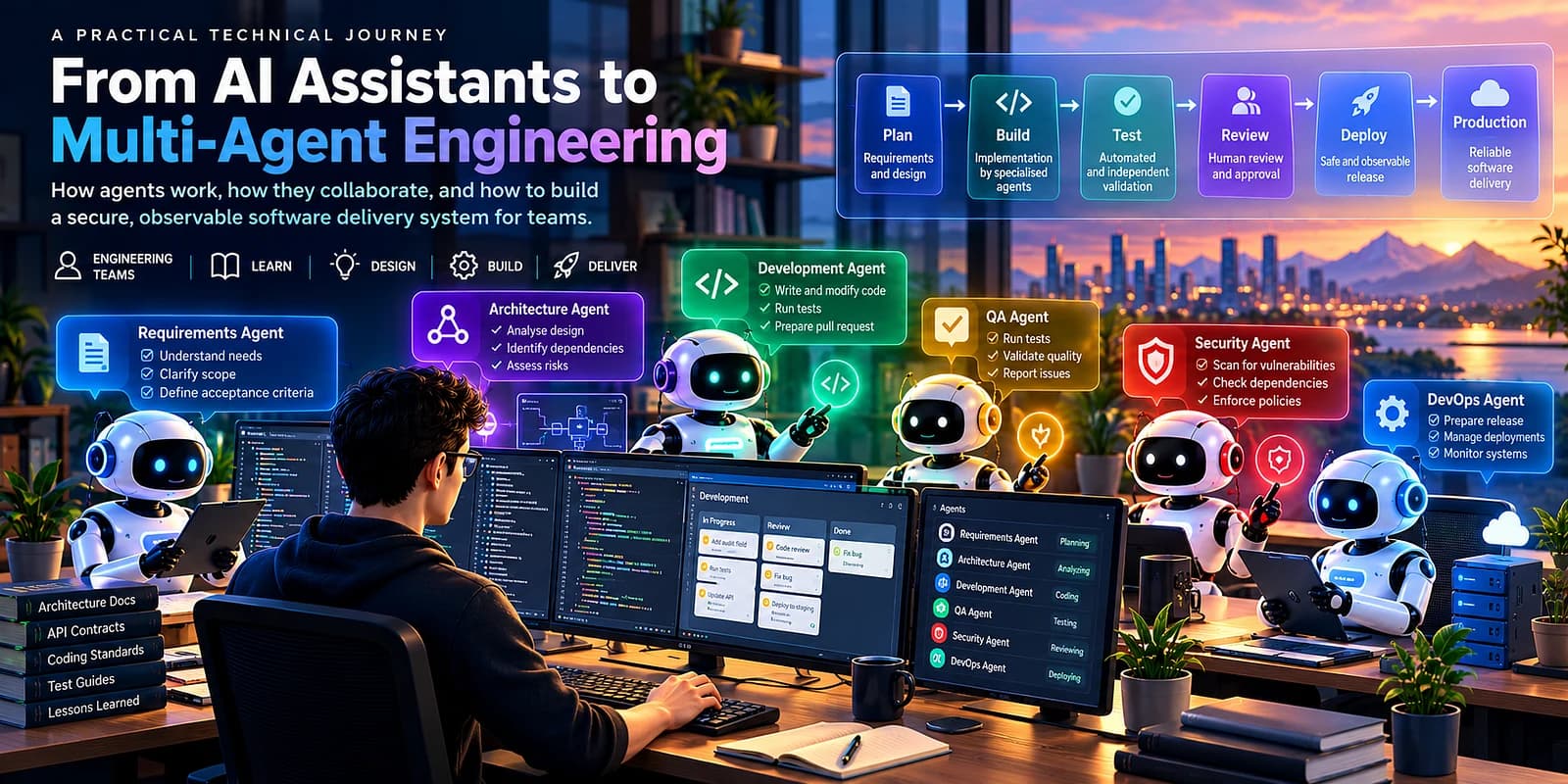
Software development is moving beyond AI that merely suggests code. Modern coding agents can inspect repositories, modify files, run commands and validate changes. The next challenge is coordinating specialised agents into reliable engineering workflows — not simply adding more automation.
1. From AI assistants to agentic development
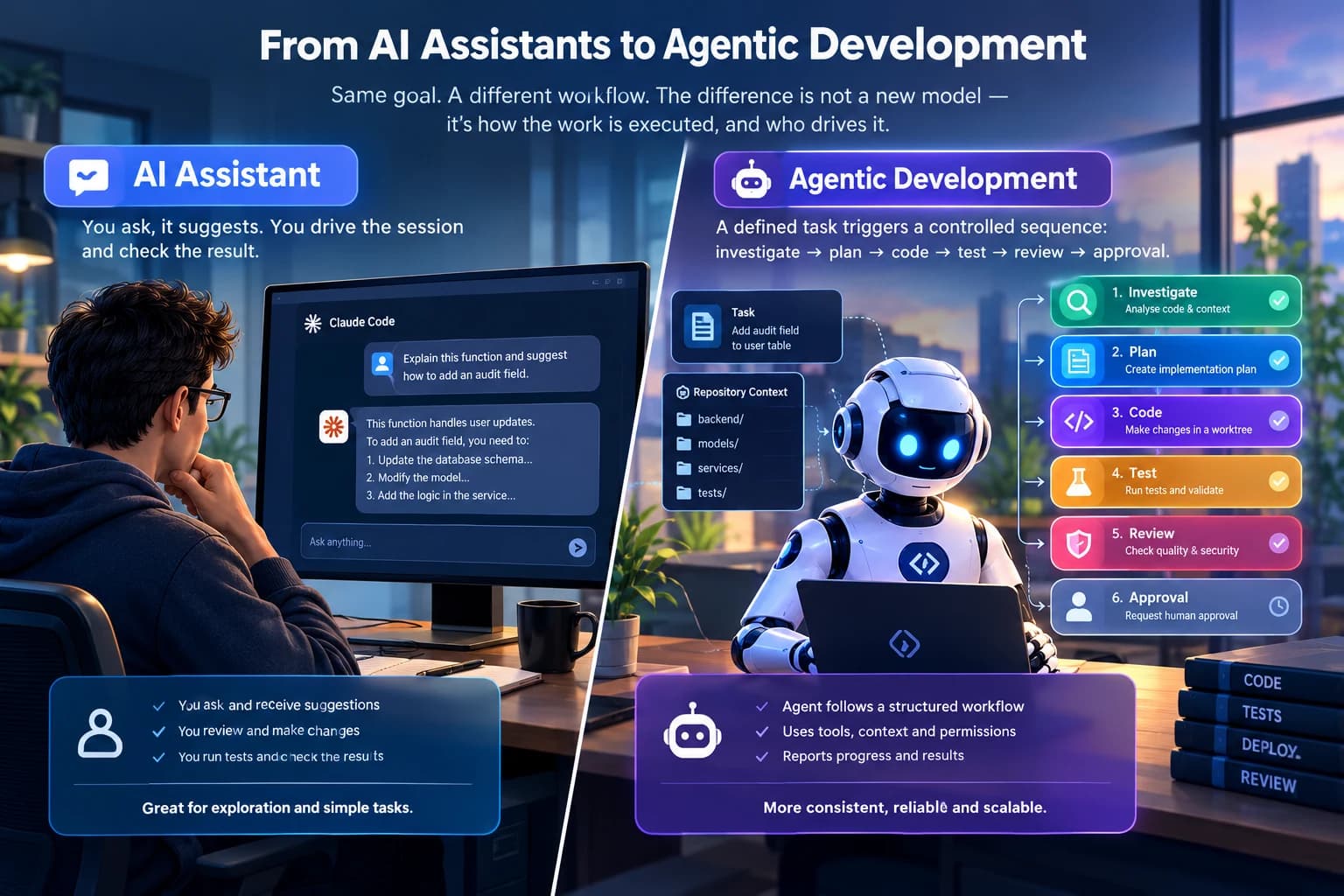
An AI-assisted developer asks a tool to explain a function or propose a change. In an agentic workflow, a scoped task can trigger investigation, planning, implementation, testing, review and approval. The difference is tool-driven execution and controlled workflow state, not a magical new model.
2. Model, assistant, agent and workflow
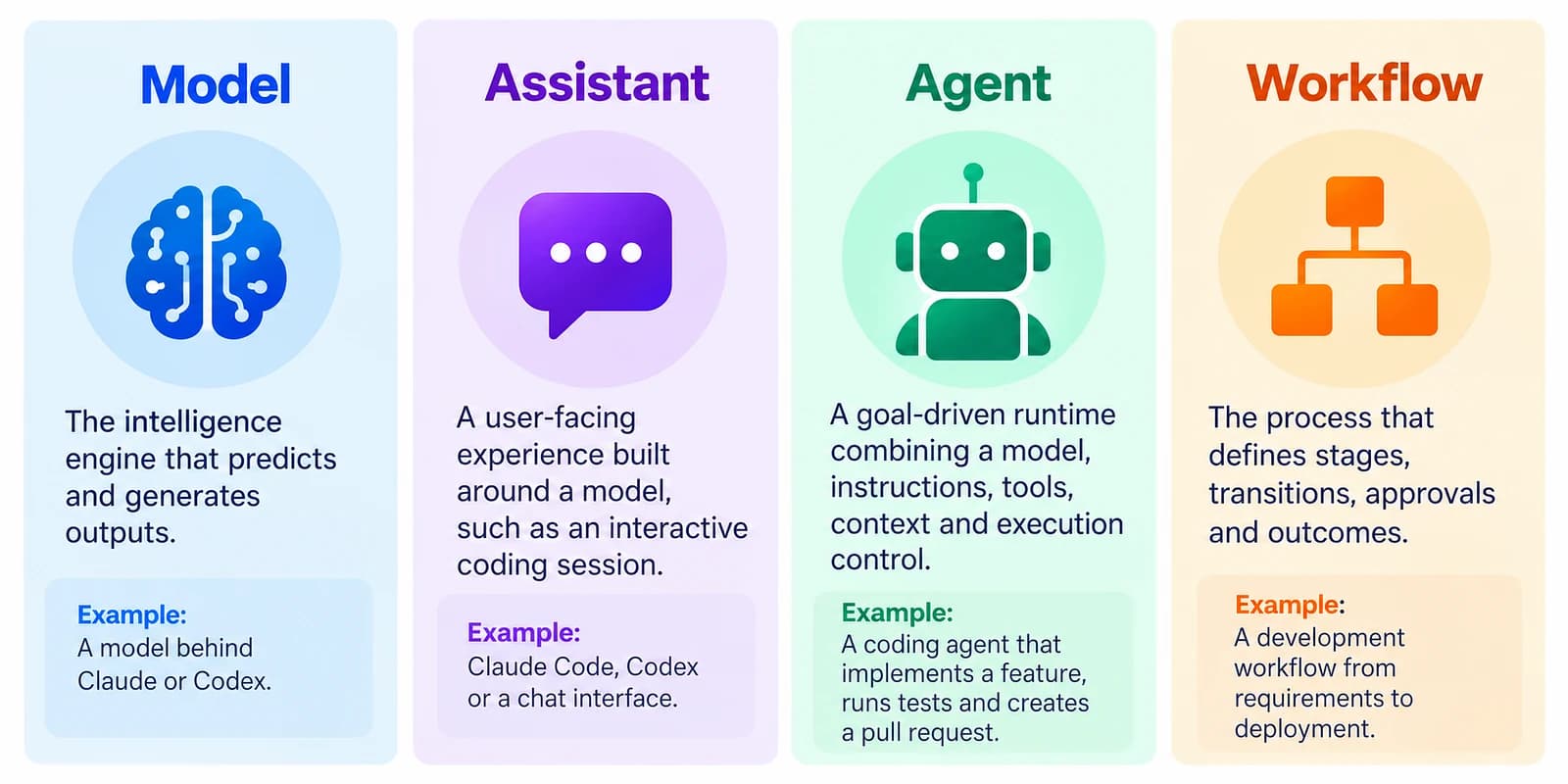
A model generates outputs. An assistant provides a user-facing experience around a model. An agent combines a model with instructions, context, tools and execution control. A workflow defines stages, transitions and approvals, many of which should remain deterministic.
3. How a single agent actually works
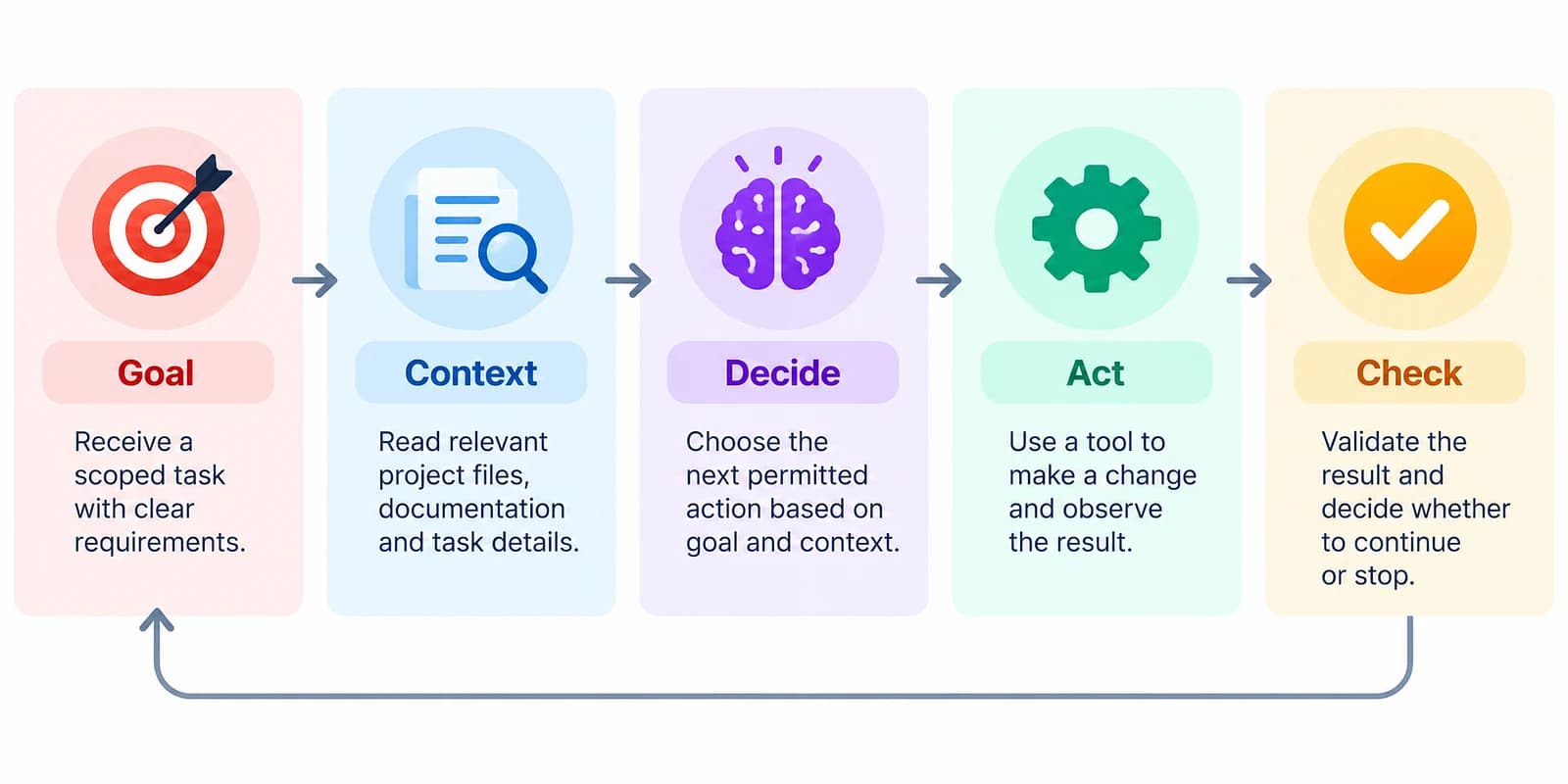
The practical loop is goal → context → decide → act → check. The model proposes the next action; the runtime executes permitted tools, captures results and decides whether to continue. Every operation needs a clear scope, timeout and observable outcome.
4. An agent is more than a prompt
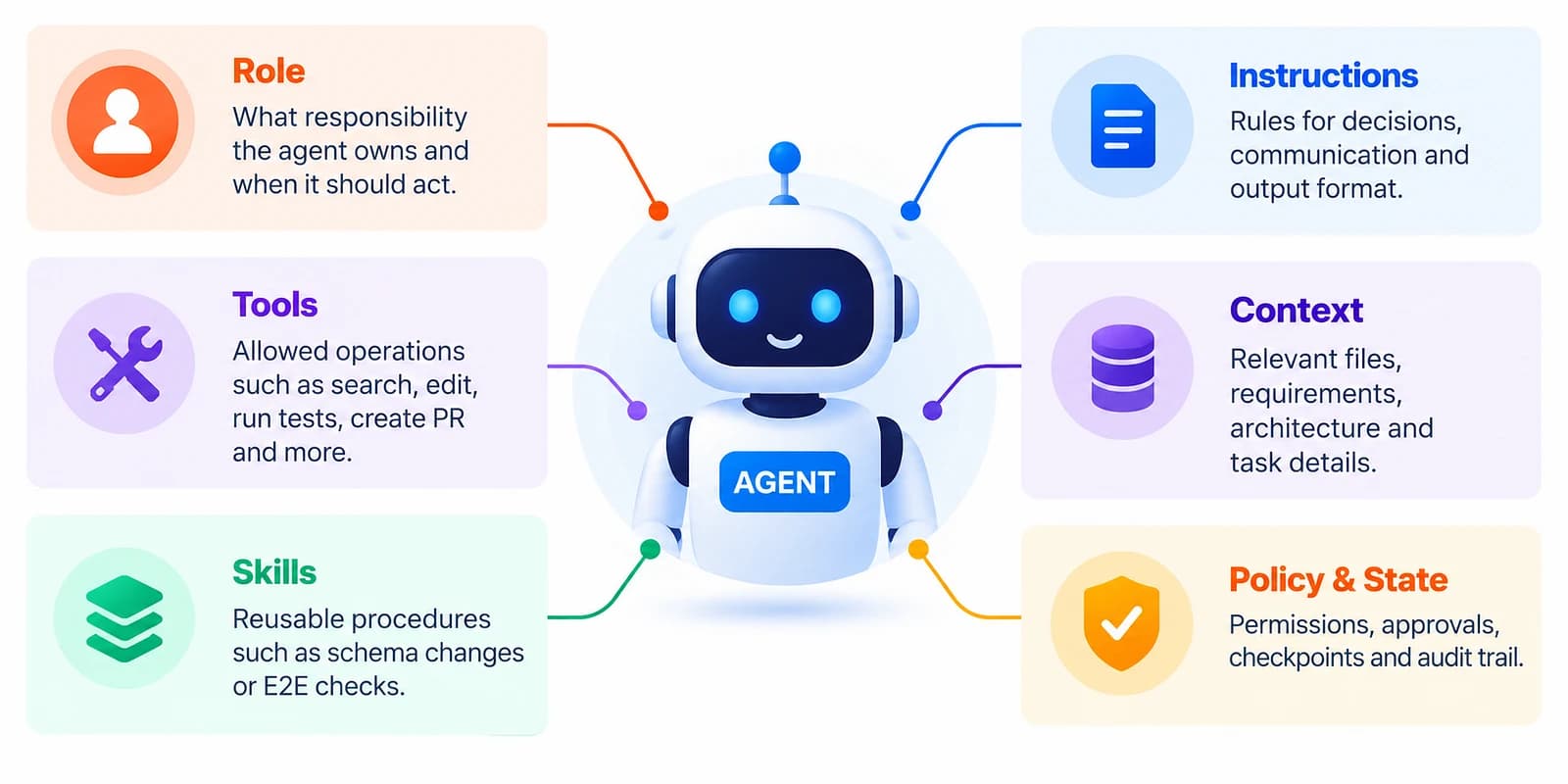
Production agents require role boundaries, instructions, tool permissions, task context, reusable skills and durable state. A QA reviewer and a deployment worker should not share unrestricted credentials. Prompts guide behaviour; policies and infrastructure enforce it.
5. Tool use and MCP
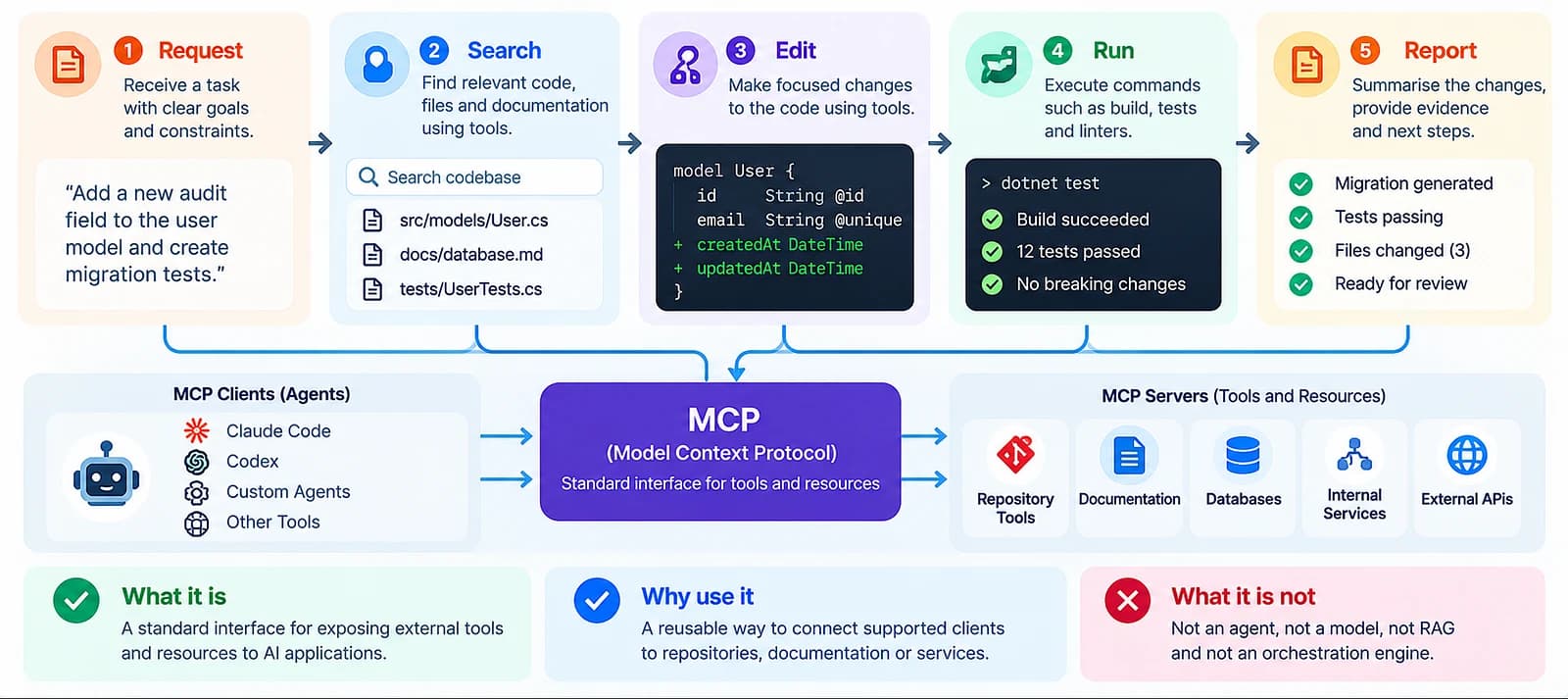
A coding agent can search for affected symbols, edit a scoped worktree, run tests and report evidence. This is usually an iterative loop rather than a single model response.
Model Context Protocol (MCP) standardises how compatible AI applications connect to tools and resources. It is not itself a model, an agent, RAG or an orchestration engine. Treat tool output as untrusted and limit access to approved capabilities.
6. Context engineering and RAG
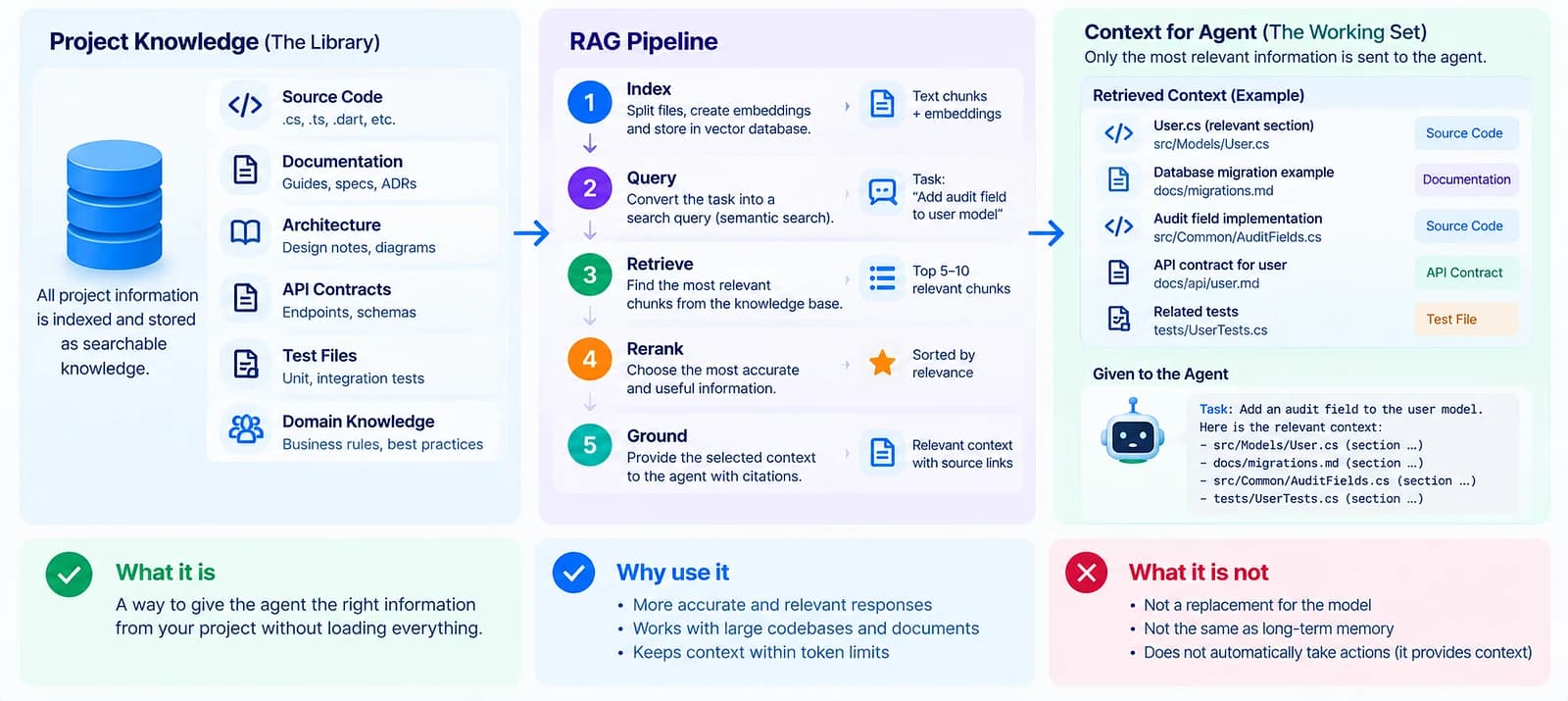
Large repositories cannot be copied wholesale into every prompt. Index files, symbols, documentation and metadata; retrieve relevant candidates; rerank for accuracy and freshness; then provide compact, traceable excerpts. Exact code and symbol search often deserves priority over embeddings.
7. Memory is not workflow state
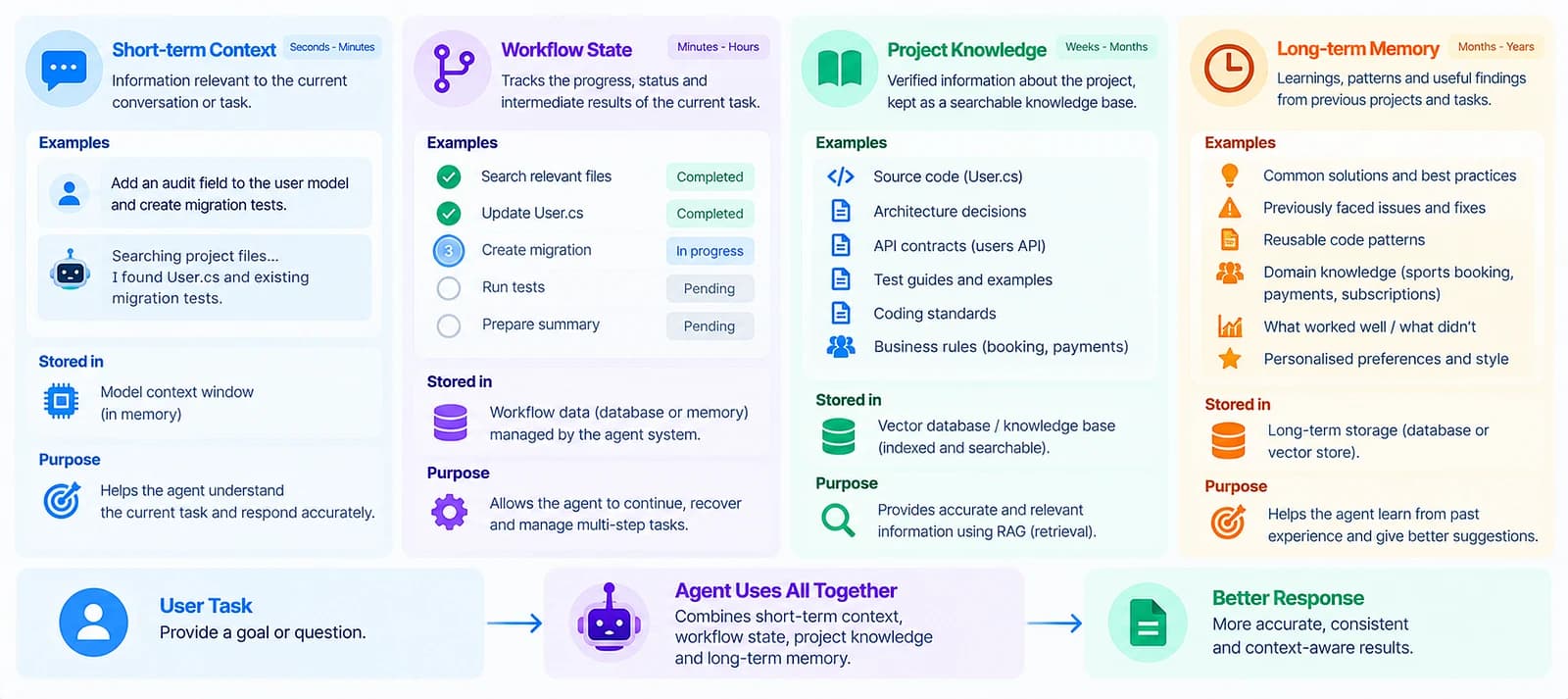
Short-term context supports the current task. Workflow state tracks ownership, handoffs, retries and approvals. Project knowledge contains reviewed architecture and standards. Long-term memory captures curated lessons, with source evidence and expiry. Automatically sharing every agent observation creates stale and contradictory knowledge.
8. Why multiple agents — and when not to use them
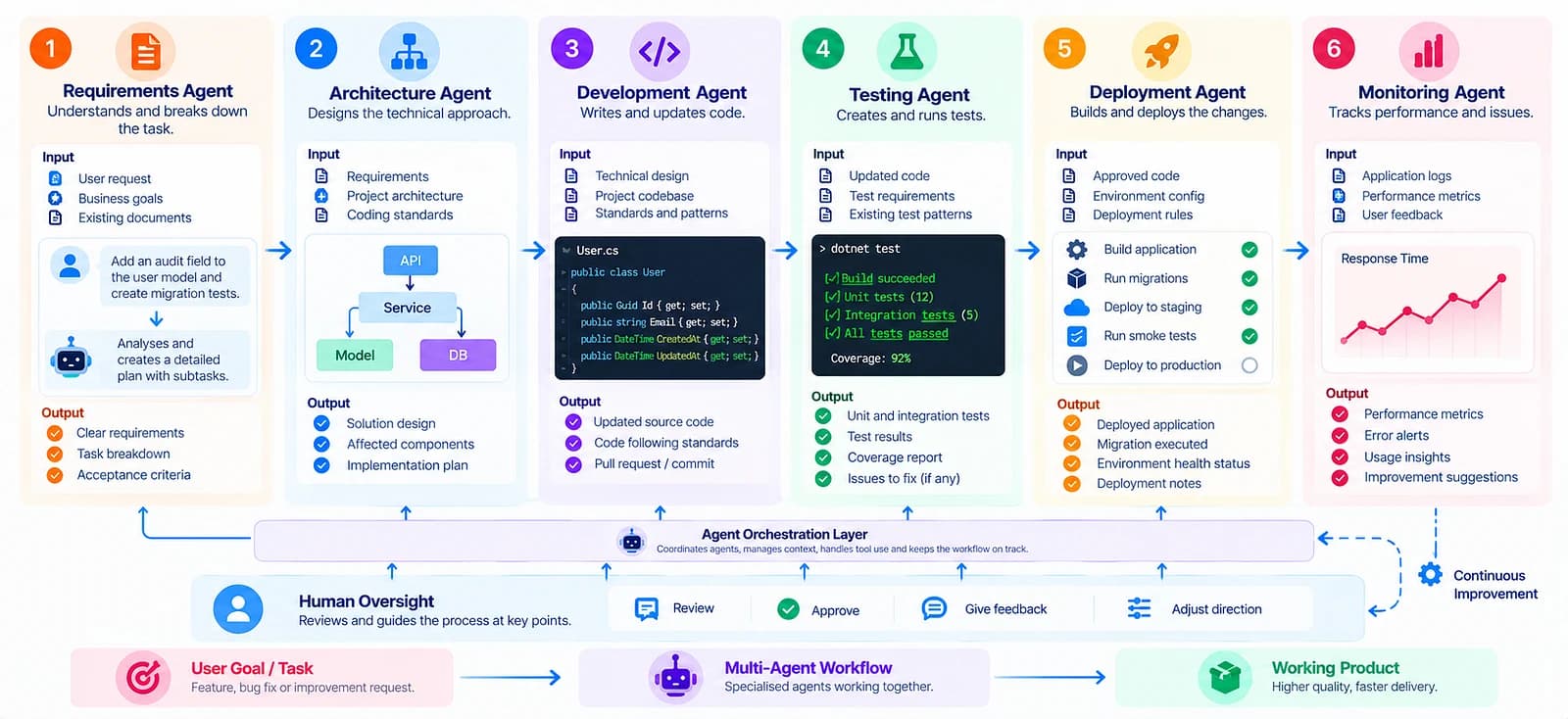
Specialists can divide requirements, architecture, development, QA, security and release responsibilities. An orchestrator activates only the agents needed, assembles scoped context and checks structured handoff contracts. Parallel work is helpful when dependencies and file ownership are clear; otherwise it adds conflict, latency and cost.
9. Security, observability and human control
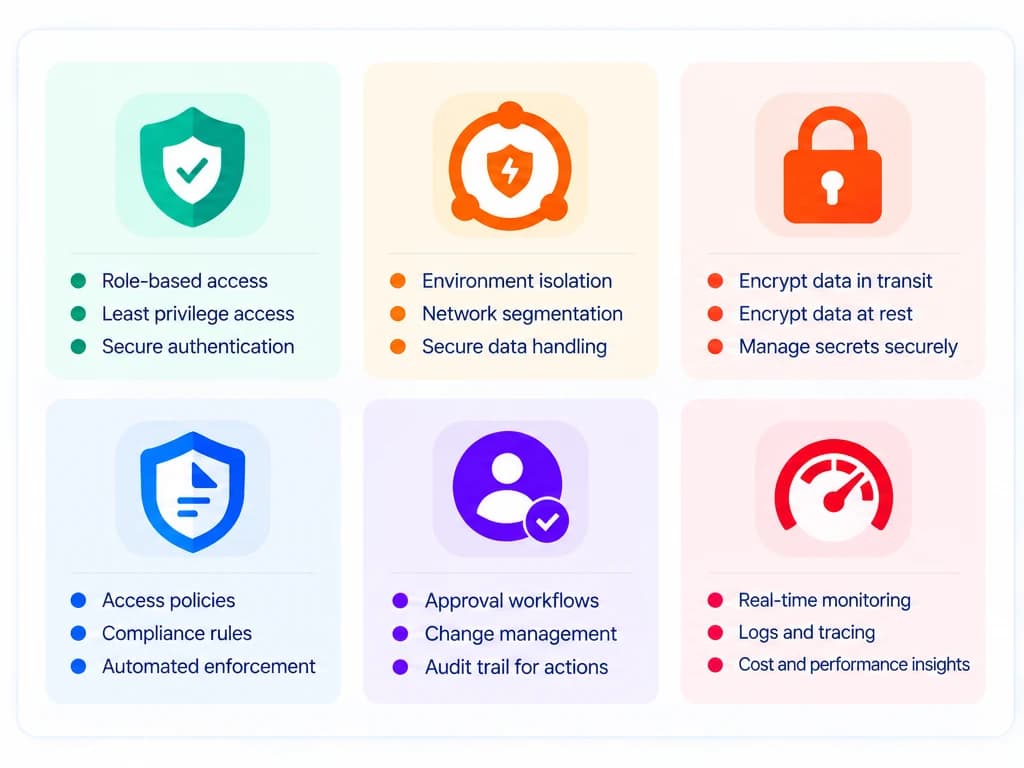
Least privilege, isolated worktrees or stronger sandboxes, secret handling, policy checks and human approval gates are essential. Record task IDs, tool outcomes, diffs, tests, handoffs, costs and failures. Show observable behaviour — not private model reasoning or secrets. Passing tests is useful evidence, not a substitute for engineering judgement.
10. A realistic path to greater autonomy
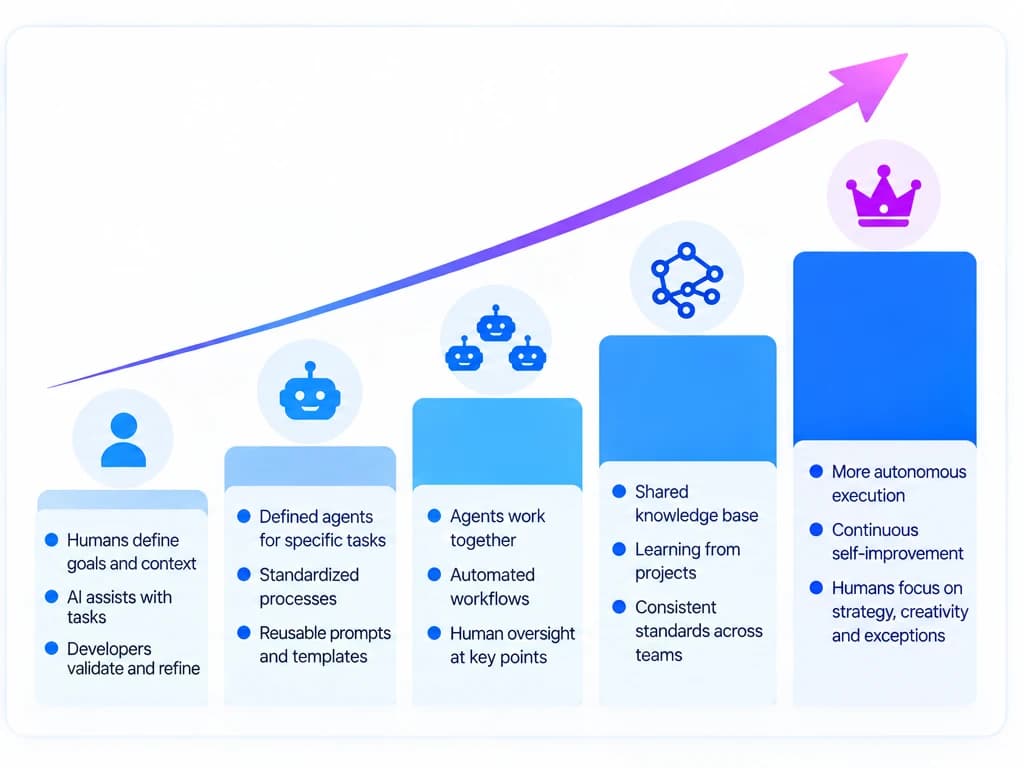
Start with supervised tasks and independently verified changes. Introduce structured agents and reusable knowledge once the basic workflow is reliable. Then invest in evaluations, recovery, permissions and selective automation. Greater autonomy should follow measured performance rather than precede it.
The Next Challenge: Shared Engineering Intelligence
As AI agents become more capable, the next challenge is not simply making them work faster. It is helping them collaborate effectively.
Imagine a development team where one engineer uses Claude Code, another uses Codex, and others build custom agents. They all contribute to the same project, but their agents may not share the same understanding of its architecture, decisions, coding standards or recent changes.
The future of multi-agent engineering may depend on shared, reliable project intelligence — knowledge that stays up to date, respects access permissions and remains accessible across different AI tools.
The goal is not to force every developer into the same AI platform. It is to let independent agents work with consistent, trustworthy information while preserving developer flexibility.
Final Thought
The future of software engineering is not about replacing developers with autonomous agents. It is about changing how software is designed, developed, tested and delivered.
AI agents can investigate problems, implement changes, run tests and coordinate complex workflows. But successful engineering requires more than automation. It requires reliable context, clear responsibilities, measurable results and appropriate human oversight.
The best multi-agent system will not be the one with the most agents. It will be the one that consistently delivers reliable software with less unnecessary effort.
And that is where the next generation of AI-powered software engineering is heading.